
Roof Moss Removal in Flintshire: Scraping, Biocide & Soft Washing Explained
Roof moss before professional manual removal and treatment. Finished result following manual roof scraping, without a biocide treatment.
12 to 15 Min read
Written by Ollie Edward
If you've got moss growing on your roof, you've probably already discovered that everyone seems to have a different opinion about what you should do with it.
Some people will tell you to scrape it off. Others will recommend spraying it with a chemical treatment.
You'll see companies advertising soft washing, while others are happy to turn up with a pressure washer
and blast the whole roof clean.
So, what is actually the best way to remove moss from a roof?
The honest answer is that there isn't one method that's right for every roof.
The condition of the tiles, the amount of moss, the age of the roof, access, surrounding areas and the homeowner's own preferences can all affect the approach.
At Ollie Edward Services, I believe in explaining the options properly before starting work. That means telling you why I recommend a particular method, what the benefits are, what the potential drawbacks are and what you can realistically expect afterwards.
No scare tactics. No telling you that your roof is about to fall apart just to win a job. And no trying to sell you something you don't want after I've explained the options.
In this guide, I'll explain how I approach roof moss removal, why scraping is often an important first step, what a biocide treatment actually does, what soft washing means and why I don't pressure wash tiled roofs.
Roof Moss Removal: What Is the Best Way to Remove Moss From a Roof?
For a heavily moss-covered tiled roof, my preferred approach will often be to carefully remove the bulk of the moss manually using appropriate scraping tools, followed by a suitable low-pressure biocidal treatment where appropriate and agreed with the homeowner.
The scraping deals with the heavy, visible moss.
The biocide treatment can then help deal with remaining biological growth and slow down regrowth over time.
This approach avoids relying on aggressive high-pressure water while still tackling both the visible moss and the biological growth that can remain behind.
However, every roof is different, which is why I believe the roof should be assessed before deciding on the best method.
The method should suit the roof — not the other way around.
Why does moss grow on roofs?
Moss loves damp conditions, and unfortunately, the British weather gives it plenty of opportunities to grow.
Roofs that are north-facing, shaded by trees or surrounded by vegetation can be particularly prone to moss, algae and other organic growth.
Areas that receive less sunlight can stay damp for longer, giving moss the ideal environment to establish itself.
Once it starts growing, it can gradually spread across the roof and build up around tile overlaps and edges.
I've seen roofs with just a light covering of moss and others where it has built up into thick clumps across large areas.
And before anyone panics, having moss on your roof doesn't automatically mean you have a serious roofing problem.
That's something I think is important to say.
Unfortunately, there are people out there who will see a moss-covered roof and immediately start telling the homeowner that the tiles are ruined or the roof is about to fail.
Sometimes there may be genuine issues underneath the moss. Other times, there may not be.
The only honest approach is to assess what is actually there.
Is moss on a roof actually a problem?
It can be.
Heavy moss growth can hold moisture against the roof surface and eventually break away into gutters and downpipes.
Anyone who has ever cleaned a badly blocked gutter will know how much moss can end up in there.
A roof can be completely covered in moss, then after a period of rain, frost or strong winds, large pieces start breaking away. That material has to go somewhere — and quite often, that somewhere is your guttering.
Heavy moss growth can also make it more difficult to properly see the condition of the roof underneath.
If tiles are cracked, slipped or damaged, thick moss can hide those problems.
So, removing excessive moss isn't just about making the property look better. It can also help keep gutters clearer and make it easier to inspect the roof covering properly.
That said, I'm not going to tell someone they must have their roof cleaned simply because I can see a bit of moss.
The amount of growth, the condition of the roof and the homeowner's concerns all need to be taken into account.
How do I remove moss from a roof?
Before I even think about putting a scraper near a roof, I want to know what I'm dealing with.
What type of roof is it?
What condition do the tiles appear to be in?
How heavy is the moss growth?
What's underneath the roofline?
Is there a conservatory, greenhouse, pond, patio or a garden full of plants that needs protecting?
And just as importantly, how can the work be carried out safely?
Once I've assessed the job, I can decide on the most appropriate method.
For a roof with significant moss growth, the first stage is often manual removal.
Roof scraping: removing the bulk of the moss
Roof scraping is exactly what it sounds like — but it's important that it isn't confused with aggressively attacking the roof.
Using appropriate tools, the visible and established moss is carefully removed from the roof covering.
The idea is to remove the bulk of the moss without relying on high-pressure water to blast it away.
This can be a slower and more labour-intensive process, but personally, when I'm working on someone's roof, I'd rather take my time than rush the job just to create an instant before-and-after photograph.
As the moss is removed, it is managed carefully to minimise unnecessary mess and to prevent large amounts simply ending up sitting in the gutters.
The roof and gutters can then be checked and cleared as part of the overall process.
Scraping can make a huge immediate difference to the appearance of a property.
But there is an important question that often comes next:
Is scraping alone enough?
Why I often recommend a biocide treatment after scraping
Scraping removes the bulk of the visible moss.
What it doesn't necessarily do is remove all of the remaining biological growth from the roof surface.
This is where a suitable biocide treatment can come in.
A biocide treatment is designed to help control unwanted organic growth such as moss, algae and lichen.
It isn't there simply to make the roof look clean on the day.
The idea is that, after the heavy moss has been physically removed, the treatment can deal with remaining biological contamination and help slow down regrowth.
Think of it like this:
Scraping deals with the bulk you can see.
Treatment helps deal with what is left behind.
That is why, where suitable, I often recommend the two methods together.
But do you have to have biocide after a roof scrape?
No.
And this is where I think being honest with customers really matters.
I recently carried out a roof moss removal job where the customer specifically wanted the roof scraped but didn't want a biocide treatment afterwards.
Before starting the work, I explained why I would normally recommend the treatment.
I explained that scraping would remove the visible moss, but a suitable biocide treatment could help deal with the remaining biological growth and potentially slow down how quickly the moss returned.
The customer understood the reasons behind my recommendation.
They still didn't want the biocide.
And that was absolutely fine.
Once I had given them the information and explained my professional recommendation, the decision was theirs.
I carried out the roof scrape as requested and respected their choice not to have the additional treatment.
For me, that's how it should work.
My job is to give you honest advice and explain the options. It's not to pressure you into buying something you don't want.
If I believe a treatment will give you a better or longer-lasting result, I'll tell you why.
But ultimately, it is your home and your decision.
What exactly is a biocide treatment?
A biocide is a product designed to control biological organisms.
In exterior cleaning, suitable biocidal treatments can be used to tackle organic growth including moss, algae and lichen.
After a roof has been scraped, the treatment is applied using a controlled, low-pressure method.
It isn't about getting on the roof with a pressure washer and blasting chemicals everywhere.
The product needs to be applied carefully and in accordance with the manufacturer's instructions.
Weather conditions matter.
The surrounding environment matters.
Plants, ponds, drainage, neighbouring properties and other vulnerable areas all need to be considered.
This is one of the reasons I wouldn't recommend somebody simply buying a strong chemical and spraying their roof without understanding how it should be used.
How do I apply a roof biocide treatment?
Where a biocide treatment has been agreed and is appropriate for the roof, it is applied using a controlled low-pressure application method.
The aim is to apply the treatment evenly without using unnecessary force against the roof covering.
Before application, I consider the surrounding areas and take appropriate precautions for things such as plants, patios, drainage and other surfaces.
I also check the weather.
There is little point applying a treatment in unsuitable conditions and hoping for the best.
Once applied, the treatment is given time to work.
And this is something homeowners should understand before booking the job:
The roof may not look perfect immediately after the treatment.
Unlike pressure washing, where you can see an instant transformation, biological treatments can continue working over time.
Remaining staining and organic growth may gradually break down and weather away.
So, a proper treatment isn't always about getting the most dramatic photograph on the day the job is finished.
It's about using a method that is appropriate for the roof and allowing the treatment to do what it is designed to do.
What are the advantages of using biocide?
There are several reasons why I often recommend a suitable treatment following manual moss removal.
It helps deal with remaining biological growth
Even after the visible moss has been removed, there can still be algae, spores and other organic contamination left on the roof.
It can help slow regrowth
A treatment can help reduce the speed at which moss and other organic growth return.
That doesn't mean the roof will stay moss-free forever — no honest contractor should promise that — but it can help improve the longevity of the clean.
It works without high pressure
The treatment is applied at low pressure, avoiding the need to aggressively blast the roof surface with water.
It can improve the overall long-term result
A roof that is scraped and treated may stay cleaner for longer than a roof where the visible moss has simply been removed and nothing further is done.
Of course, results will always depend on the property.
A roof surrounded by mature trees and permanent shade is going to have a very different environment from one that gets full sunlight for most of the day.
Are there any disadvantages to biocide treatment?
Yes — and I think customers should know those as well.
A biocide is a chemical treatment, so it needs to be handled responsibly.
The right product needs to be selected and applied correctly, and the surrounding environment needs to be considered.
Particular attention may be needed around:
Plants and lawns
Ponds and water features
Drainage
Painted or delicate surfaces
Conservatories
Vehicles
Neighbouring properties
Pets and people
There is also the fact that results may take time.
Some homeowners want an instant transformation, and if that's what they're expecting, it's important to explain how a treatment works before the job starts.
I would always rather have that conversation beforehand than promise someone an unrealistic result.
What is soft washing?
Soft washing is a term that gets used a lot in exterior cleaning, but not everyone knows exactly what it means.
Put simply, soft washing is a low-pressure cleaning and treatment method that relies more on the cleaning solution and its ability to deal with organic growth than on the force of water.
Compare that with pressure washing.
With a pressure washer, the mechanical force of the water does a large part of the cleaning.
With soft washing, the aim is to use controlled chemical action and low pressure instead.
For roofs, this can make far more sense than treating the tiles like a patio.
Depending on the roof and the level of contamination, a soft washing approach may be used as part of the overall cleaning and treatment process.
Again, though, there isn't one process that suits every roof.
That's why assessment comes first.
Why I don't pressure wash tiled roofs
This is probably one of the questions I get asked most.
"Can't you just pressure wash it?"
The simple answer is: I don't believe a tiled roof should automatically be treated like a driveway.
I use pressure washing for plenty of exterior surfaces. It is an excellent cleaning method when used on the right surface and with the right equipment.
But roofs are different.
Tiles are part of your property's weatherproofing system.
They can be old, weathered or already damaged. Mortar, pointing and other roof components can also be vulnerable.
Using high-pressure water on a roof can potentially cause problems including:
Disturbing or damaging fragile tiles
Forcing water where it shouldn't go
Affecting already-weathered roof coverings
Dislodging loose or compromised tiles
Damaging vulnerable mortar or pointing
Removing surface material from certain roof coverings
And perhaps most importantly, a roof can look absolutely fantastic immediately after being pressure washed.
But an impressive before-and-after photograph doesn't tell you everything about the condition the roof has been left in.
The cleanest-looking roof on Facebook isn't necessarily the best-cleaned roof.
Personally, I would rather use a method that takes longer and treats the roof with more care than chase the fastest possible transformation.
The problem with instant transformations
We've all seen the videos.
Half the roof is bright and clean.
The other half is dark and covered in moss.
The pressure washer moves across the tiles and within seconds there is a massive difference.
And don't get me wrong — visually, it looks impressive.
But when you're choosing someone to work on your roof, I'd encourage you to look beyond the video.
Ask how the work is being carried out.
Ask why that particular method has been chosen.
Ask whether the roof has been assessed first.
And don't be afraid to ask questions about what could happen if something goes wrong.
A professional should be happy to explain their process.
Why choosing the right roof cleaning company matters
Roof cleaning isn't just another pressure washing job.
You're working at height, often on sloping surfaces that can be slippery and fragile.
There may be:
Conservatories underneath
Skylights
Solar panels
Gutters and downpipes
Ponds
Delicate gardens
Neighbouring properties
Vehicles
Existing roof defects
And then there is the roof itself.
Before any cleaning method is chosen, you need to understand what you're working on.
That's why I believe a professional roof cleaning service should involve more than someone arriving with a pressure washer, climbing a ladder and getting started.
The access needs to be considered.
The condition of the roof needs to be considered.
The cleaning method needs to be considered.
And the surrounding property needs protecting.
Be careful of scare tactics and high-pressure sales
Unfortunately, roofing and roof cleaning can attract rogue traders.
One of the biggest warning signs for me is someone who turns up uninvited and immediately starts telling you that your roof is in serious danger.
You've probably heard some of the stories:
"I was passing and noticed your roof is damaged."
"You've got tiles that need urgent work."
"If you don't sort this today, you'll end up with thousands of pounds of damage."
"We're working in the area and can do you a special price — but only today."
That doesn't automatically mean every person offering roofing work is dishonest.
But pressure and fear should never be the reason you agree to work on your home.
If somebody tells you there is a serious problem, ask them to show you.
Ask for photographs or evidence.
Get another opinion if you're unsure.
Ask for a written quotation explaining exactly what is being recommended.
And never feel pressured into making a decision on the doorstep.
The same applies to roof cleaning.
Moss on a roof is not a licence for somebody to scare you into spending thousands of pounds.
A real example I've come across
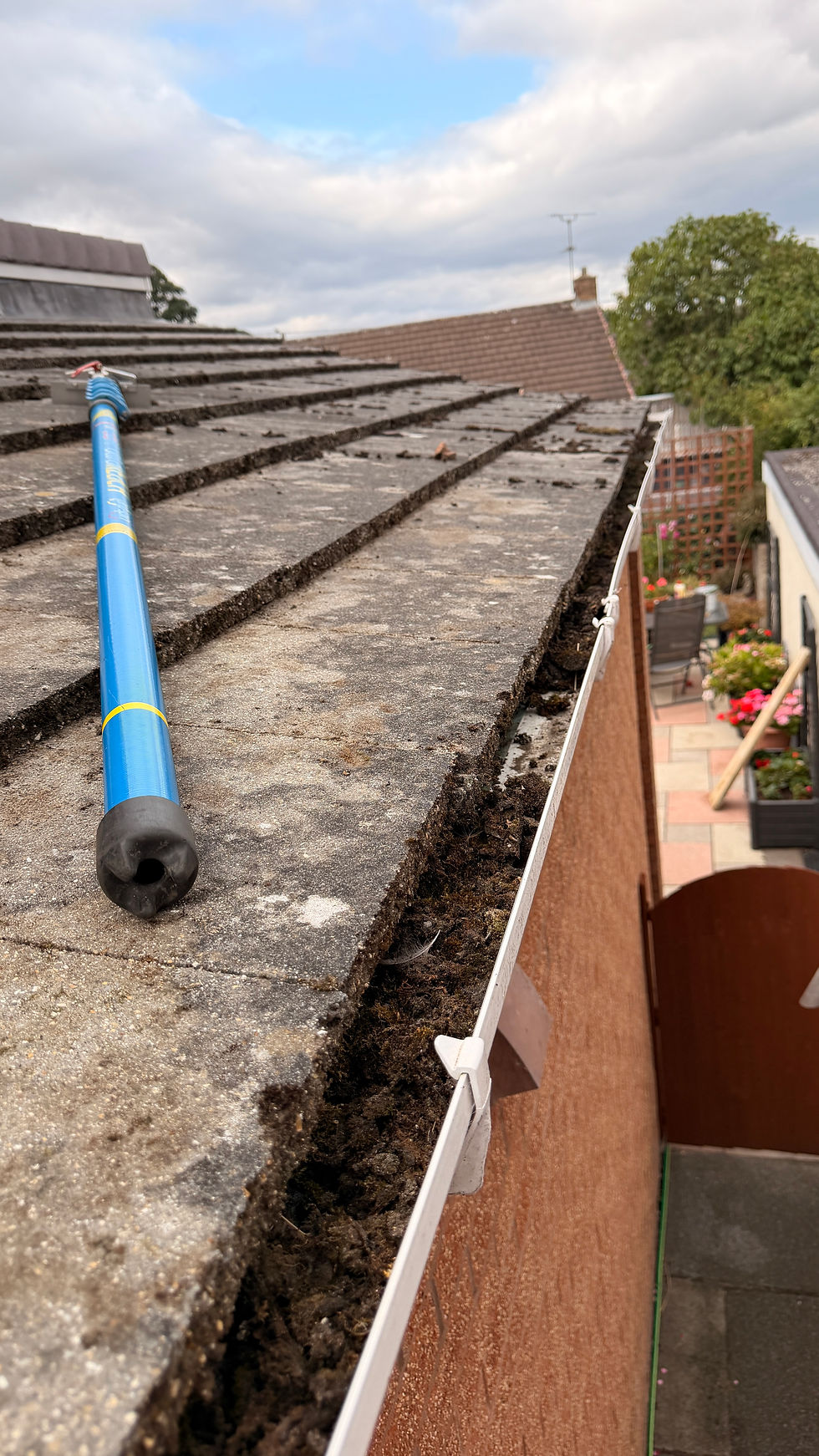
The photos below are from a recent property where I was attending to install new guttering. To be completely clear, the previous roof cleaning shown in these photos was not carried out by Ollie Edward Services.
The previous homeowner had the roof cleaned by another contractor using what appeared to be a high-pressure washer with a turbo nozzle.
While I was there, I noticed areas where the surface of the roof tiles appeared to have been aggressively cleaned, with the finish visibly affected.
There was also still moss and organic growth remaining between some of the tiles.
I'm not including these photos to criticise another contractor or make claims about work I wasn't present for.
I'm including them because they are a real example of why it's important to ask how your roof is going to be cleaned before agreeing to the work.
A dramatic before and after result or a cheap price doesn't always tell the full story. Ask questions, understand the method being used and make sure you're comfortable with the approach before anyone starts work on your roof.
Areas of the roof where the tile surface appears to have been aggressively cleaned. The roof surface after previous high-pressure cleaning, with organic growth still remaining. Close-up of remaining moss and affected roof tile surface after previous high-pressure cleaning
What should you ask before having your roof cleaned?
If you're looking at roof moss removal, here are a few questions I'd recommend asking.
What method are you planning to use?
Ask whether the company is proposing:
Manual scraping
Soft washing
Biocide treatment
Pressure washing
Or a combination of methods
"Roof cleaning" is a broad term. You should know exactly what is going to happen to your roof.
Why have you chosen that method?
A good contractor should be able to explain why they believe their approach is appropriate for your particular roof.
Is a biocide treatment included?
If it isn't included, ask whether it is recommended and why.
Likewise, if it is included, ask what the treatment is expected to achieve.
How will the surrounding property be protected?
This is particularly important if you have plants, a pond, a conservatory or other vulnerable areas below the roof.
What happens to the moss afterwards?
Removing moss from the roof is one thing.
Making sure it isn't left blocking the gutters or scattered around the property is another.
Are you insured?
Don't be afraid to ask.
A professional contractor should understand why a customer wants reassurance.
How long does roof moss removal last?
This is another question where I think honesty is important.
There is no exact answer.
No one can look at a roof and honestly guarantee that moss will never come back.
How quickly it returns can depend on:
How much shade the roof receives
Nearby trees
Moisture levels
The direction the roof faces
Local weather conditions
The condition and type of roof covering
A suitable biocide treatment can help slow regrowth, but it isn't a magic forcefield.
Your roof is outside 365 days a year, exposed to rain, wind, organic matter and airborne spores.
The aim is to clean and, where agreed, treat the roof properly — not make unrealistic promises.
Can you remove roof moss yourself?
Some homeowners do choose to tackle moss themselves.
But before doing so, I'd strongly recommend thinking about the risks.
Roofs are not flat patios.
Working at height on a sloping roof can be dangerous, particularly when moss, damp conditions and potentially fragile tiles are involved.
There is also the risk of damaging tiles or disturbing the roof covering if the wrong tools or techniques are used.
And if chemicals are involved, there is an additional responsibility to understand how they should be handled and how the surrounding environment should be protected.
Sometimes, what looks like a straightforward DIY job from the ground is much more complicated once you're actually up there.
My approach to professional roof moss removal
Every property is different, but my general approach is straightforward.
1. Assess the roof and surrounding areas
I want to understand the condition of the roof, the amount of moss, access requirements and anything around the property that needs particular care.
2. Plan the safest and most appropriate method
I don't believe in using the same method just because it's the quickest.
The roof should be assessed and the method chosen accordingly.
3. Carefully remove the bulk of established moss
Where appropriate, the visible moss is manually scraped using suitable tools and controlled techniques.
4. Clear the affected areas
The gutters and surrounding areas are checked so that removed moss isn't simply left to cause another problem.
5. Apply a suitable treatment where agreed
If the homeowner chooses to have a biocide treatment and it is suitable for the job, it is applied at controlled low pressure and in accordance with the product guidance.
6. Allow the treatment to work
A treated roof may continue improving after the initial visit as the remaining organic growth breaks down and weathers over time.
7. Leave the property tidy
A roof cleaning job shouldn't finish with moss scattered across the driveway, garden and gutters.
The property should be checked and left tidy.
Roof scraping, biocide or soft washing: which one is right for you?
The answer depends on the roof.
A heavily moss-covered roof may benefit from manual removal followed by treatment.
A roof with lighter organic growth may require a different approach.
Some homeowners may want the full process, while others may choose to have only the moss manually removed.
That's why I don't believe in a one-size-fits-all answer.
I'll always explain what I recommend and why.
If you decide you want something different, I'll explain the likely pros and cons so you can make an informed decision.
Just like my recent customer who chose to have their roof scraped without the additional biocide treatment.
I recommended the treatment.
I explained why.
They chose not to have it.
And I respected that decision.
Simple.

Frequently Asked Questions About Roof Moss Removal
Is roof moss removal worth it?
For a heavily moss-covered roof, removing the bulk of the moss can improve the appearance of the property, help reduce moss entering gutters and make it easier to inspect the roof underneath.
Should moss be scraped off a roof?
For suitable roofs with heavy moss growth, careful manual scraping can be an effective way to remove the bulk of the visible moss without relying on high-pressure water.
The roof should always be assessed first.
Do I need biocide after roof scraping?
Not necessarily, but I often recommend considering it because it can help deal with remaining biological growth and slow down regrowth.
The homeowner can then decide whether they want that additional treatment.
What is soft washing?
Soft washing is a low-pressure cleaning and treatment method that relies more on chemical action than the mechanical force of high-pressure water.
Why don't you pressure wash tiled roofs?
I don't use high-pressure washing as my preferred method for tiled roof moss removal because of the potential risks associated with forcing high-pressure water onto roof coverings, particularly where tiles are old, weathered or vulnerable.
Will moss come back after roof cleaning?
It can.
Roofs are constantly exposed to weather, moisture and airborne spores. A suitable treatment may help slow regrowth, but no honest contractor can guarantee that moss will never return.
How much does professional roof moss removal cost?
The cost depends on several factors, including the size of the roof, access, the amount of moss present, the roof type and whether a treatment is included.
The best way to get an accurate price is to have the property assessed.
Thinking About Having Moss Removed From Your Roof?
If your roof is covered in moss and you're not sure what the best option is, the first step is simply to get the right information.
You don't need scare tactics.
You don't need somebody telling you that you have to make a decision today.
And you shouldn't have to agree to a cleaning method without understanding what is actually being done to your roof.
At Ollie Edward Services, I'll assess the job, explain the options available and give you my honest recommendation.
Whether that's careful roof scraping, a biocide treatment, soft washing or a combination of methods, the approach should be based on what is appropriate for your roof and what you are comfortable with.
No unnecessary pressure.
No confusing sales pitch.
Just honest advice and a professional approach.
Ollie Edward Services provides professional roof moss removal and exterior cleaning across Mold, Flintshire and the surrounding areas.
If you'd like to discuss your roof or arrange an assessment, get in touch today.


Comments